
Environmental Management Initiatives
1. 2025 Environmental Management Initiatives Performance
From 2024, environmental management has been comprehensively conducted centered on greenhouse gas emissions management, with environmental management results compiled. In 2025, the Company set greenhouse gas targets for the first time based on the 2023 and 2024 greenhouse gas emissions. Given that the energy source for production processes mainly depends on electric power, the Company opted for a meaningful starting point of target management rather than aggressively set targets. Company-wide greenhouse gas emissions for fiscal year 2025 increased from 7,720 tCO2eq in 2024 to 8,025.655 tCO2eq in 2025 (+3.96%). The increase factors are structural electricity demand expansion due to CGM (Continuous Glucose Monitoring) line expansion and the new operation of the Songdo No. 2 Plant. Despite the CGM line expansion, the emissions on an intensity basis declined, marking a positive result. (See Environmental FACTBOOK.)
In addition, from March 2025, the Company operated a company-wide "Carbon Neutrality in Daily Life Challenge" with the participation of all employees. The campaign centered on standby-power reduction and indoor temperature control across the entire company. R&D employees turned off power to high-capacity equipment outside business hours, and office employees turned off PC and monitor multi-tap power, switched off unnecessary lighting, prohibited personal heating devices, and used stairs. Each month, electricity usage by floor (B1F to 8F) was precisely monitored at each business site, and a "Smart Electricity Usage Notice" was shared with all employees. As a result, the Seocho Headquarters achieved a -4.5% reduction in electricity usage in 2025 compared to 2024. (See 3.5 Climate Change Mitigation Activities — Carbon Neutrality Challenge.)
2. Management Governance (E3-1·E3-2)
E3-1. Board of Directors' Oversight of Environmental Management
The Company considers environmental management not as the responsibility of some departments but as a management priority for which the Company must take responsibility, and ensures that the Board of Directors directly oversees it. At the Board of Directors meeting on February 24, 2025, the Company reported on the 2024 environmental management activity results and the 2025 annual environmental management activity plan. The report contained four main items. First, seminars and mentor-mentee activities conducted through participation in the international initiative UNGC (United Nations Global Compact). Second, ESG training received by all employees. Third, the construction of a greenhouse gas inventory to systematically grasp the greenhouse gas emissions of the Company. Fourth, the response to external assessment institutions conducted in the first and second halves of the year. Through this, the Company is starting to build a structure in which environmental performance and external assessment results are regularly checked and reviewed by management.
E3-2. Environmental Education for All Employees
The Company believes that all employees must properly understand the environment and put it into practice in daily work, and accordingly provides environmental education for all employees. In 2025, training was operated through online self-learning so that employees could study at a time of their convenience, and post-training evaluations were used to confirm understanding. The training covered topics that can be applied immediately in the field, starting with what environmental management and ESG are, how waste generated on site is managed, how chemical substances should be handled, and why environmental accidents occur and how to respond if they happen. As a result, all 901 employees, excluding those on leave and non-target personnel, completed the training, recording a 100% completion rate.
3. Climate and Natural Capital (Biodiversity Assessment / E3-3·E3-4·E3-5)
E3-3 Climate Change Scenario Analysis — Change Disclosure (GRI 3-2 · 2-4)
The Company manages climate change as a material topic of the Double Materiality Assessment. In 2024, the Company voluntarily disclosed self-prepared climate change scenarios on its website. In the 2025 Sustainability Report, these have been fully supplemented for the following four reasons, and the scenarios in this report supersede the 2024 voluntary disclosure as the latest reference.
First, upgrade of the disclosure methodology — risks and opportunities are structured into transition and physical risks in alignment with the TCFD, the international climate disclosure recommendation, and a third-party assurance framework was introduced. Second, scenario refinement — expanded from a single qualitative analysis to two scenarios (1.5°C, 2.0°C) and a distinction between short-, medium-, and long-term timeframes. Third, baseline emissions recalculation (GRI 2-4) — because the baseline emissions of the 2024 scenarios (7,720 tCO₂e) were not consistent with the energy consumption (40,000 MWh) and the electricity emissions factor (0.4594), the baseline was restated to a consistent value (approximately 17,500 tCO₂e). Fourth, redefinition of the financial impact formula — the carbon cost item was redefined from "emissions allowance purchase cost" to "carbon price exposure," and the assumptions and formulas for each estimate were specified. (See TCFD 7B for details.)
Applicable Standards
GRI 3-3 (Management of Material Topics), GRI 3-2-b (Changes in Material Topics), GRI 2-4 (Restatements of Information), GRI 201-2 (Financial Implications and Other Risks and Opportunities Due to Climate Change), GRI 305 (Emissions), TCFD (Governance, Strategy, Risk Management, Metrics and Targets).
Meanwhile, the Company's greenhouse gas emissions (Scope 1+2) increased by approximately 3.9% from 7,720 tCO2eq in 2024 to 8,025.655 tCO2eq in 2025. This is because electricity demand structurally increased due to the expansion of Continuous Glucose Monitoring (CGM) production lines and the new operation of the Songdo No. 2 Plant. Over the same period, the emissions efficiency per unit of revenue (intensity) instead improved, with the Company achieving both growth and improvement in carbon efficiency. Detailed information on short-, medium-, and long-term 3-stage scenario analyses, the basis for financial impact estimates, and changes in emissions versus the base year is consolidated and disclosed in the 06-9 TCFD Index of this report (7-A · 7-B · 7-C).
E3-4. Management of Nature-related Risks and Opportunities
The Company manages how its business sites interact with the natural environment — water, air, soil, and ecosystems — by dividing it into three areas: water, pollution, and biodiversity.
1. Water Risk
The Songdo, Songdo No. 2, and Wonju plants all receive general water supply from local municipal waterworks, and the risk of water shortage even in case of drought is low. Nevertheless, the Company sets annual targets for reducing water usage to continuously manage the water used in production processes, and treats wastewater generated after use in full through specialized commissioned providers in compliance with the law.
2. Pollution Risk
Air — In accordance with the Clean Air Conservation Act, the Company minimizes pollutants emitted into the surrounding environment by filtering THC (Total Hydrocarbons) and dust generated from production facilities through prevention facilities such as adsorption towers.
Soil and chemicals — The Company does not operate facilities that may contaminate soil. However, leak prevention devices and bunds are installed at the diesel storage facilities and chemical storage areas where small quantities are kept, preparing for any potential risk.
3. Biodiversity
Until previously, the Company had been recorded as not having separately reviewed biodiversity conservation at its business sites. However, in preparing this 2025 report, for the first time the Company conducted a full review of how its business sites affect the surrounding natural ecosystem.
To this end, applying the LEAP approach of the TNFD (Taskforce on Nature-related Financial Disclosures), the international standard for diagnosing natural environment-related risks and opportunities, the Company conducted biodiversity assessments for four business sites — Seocho Headquarters, Wonju Plant, Songdo Plant, and Songdo No. 2 Plant — and completed them on May 21, 2026.
E3-4 Supplement — TNFD LEAP 4-Site Assessment Results (May 21, 2026)
The Company completed a TNFD (Taskforce on Nature-related Financial Disclosures) LEAP framework-based biodiversity and natural capital assessment on May 21, 2026. For the four business sites — Seocho Headquarters, Wonju Plant, Songdo Plant (Harmony Road), and Songdo No. 2 Plant — the Locate (location identification) and Evaluate (dependency and impact evaluation) steps of the LEAP four-step framework were applied; the Assess and Prepare steps will be conducted as a follow-up consulting engagement.
Assessment Results — Summary of 4 Sites (as of May 21, 2026)
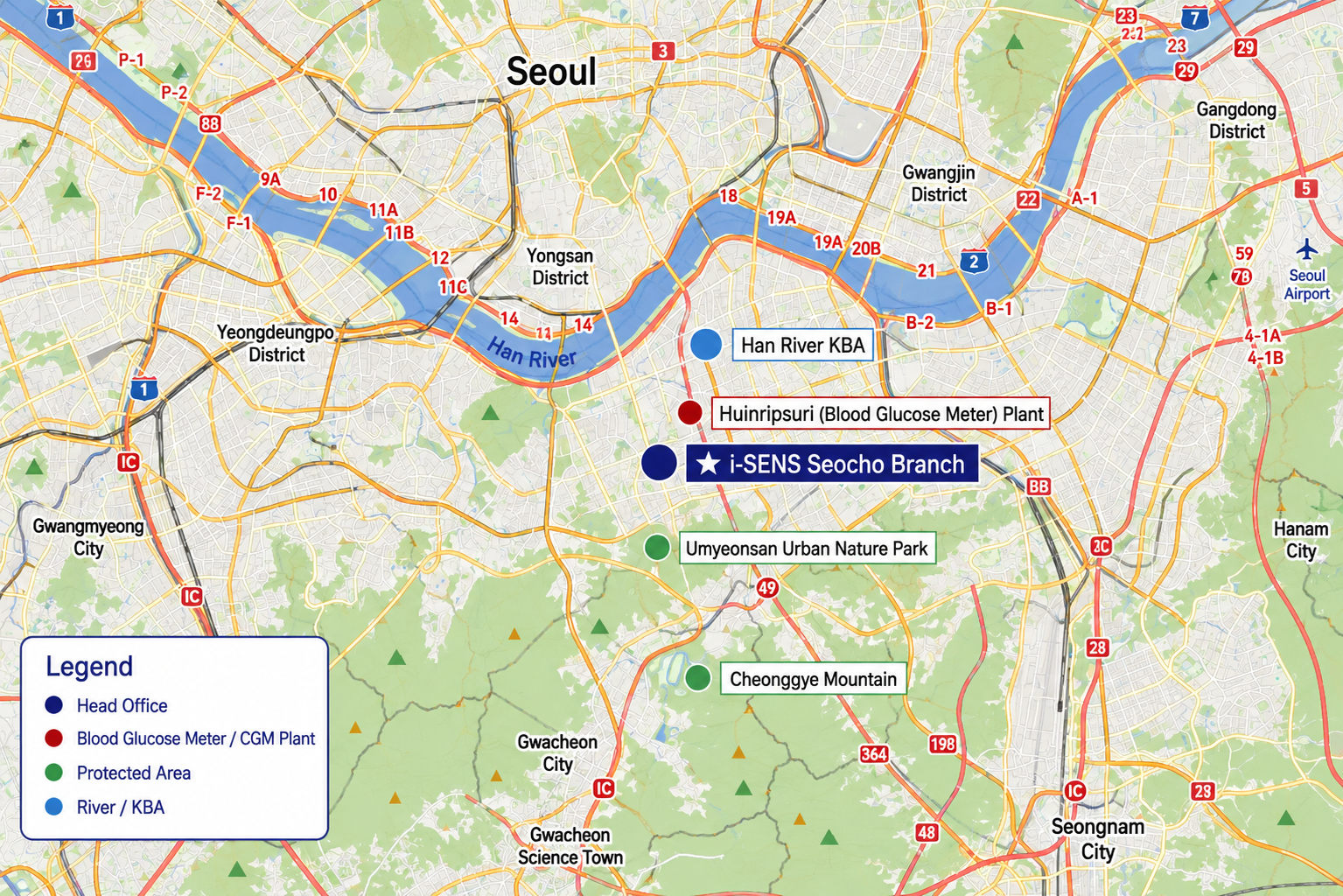
Seocho Headquarters (Seocho, Seoul · Headquarters · R&D) — Location sensitivity 5.0/5.0 · priority 54.81 · materiality "Low" · Key adjacencies: white-tailed sea eagle (endangered Class I) 0.94 km, peregrine falcon (Class I) 1.5 km, Han River KBA 2.36 km, Mt. Umyeon 1.76 km
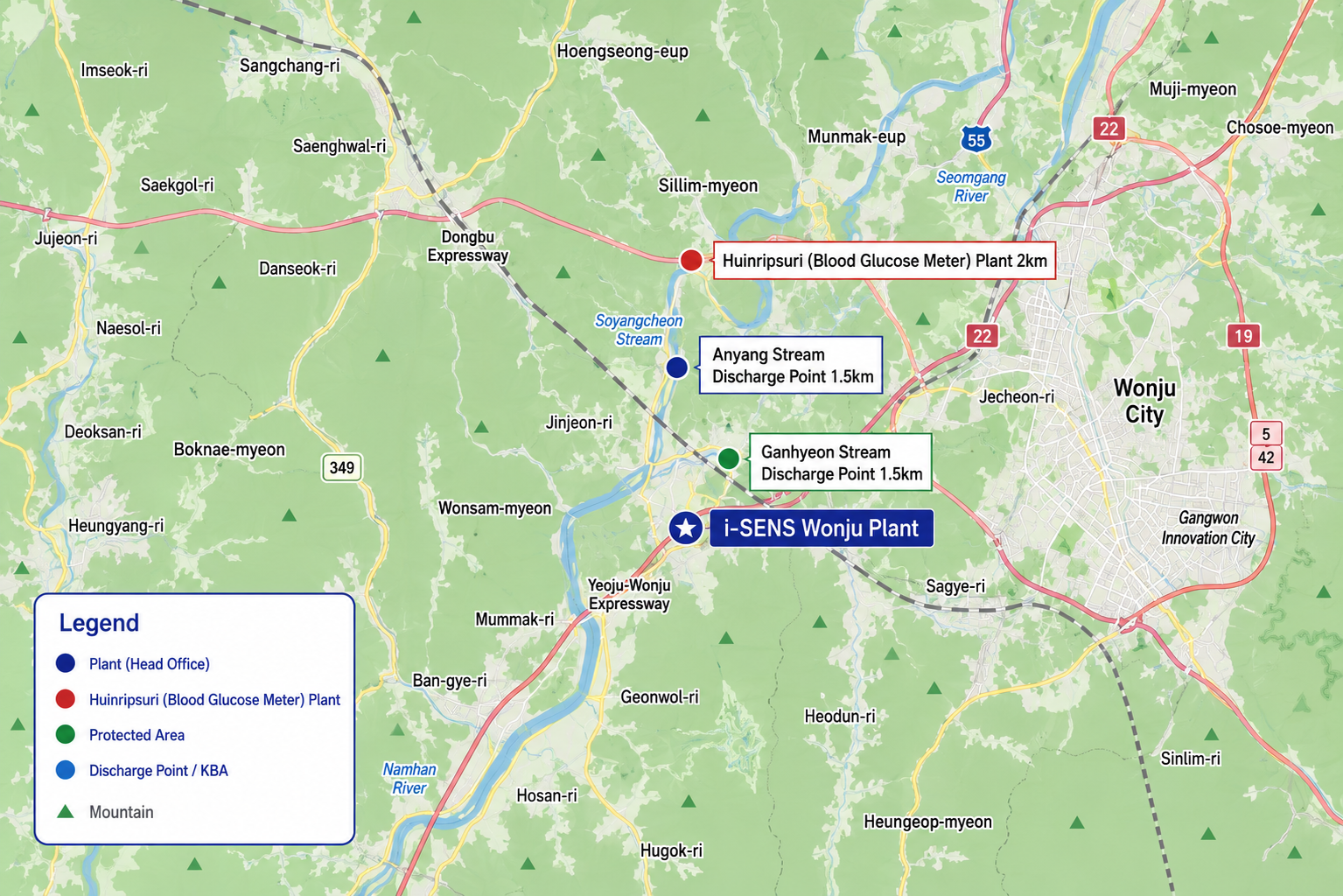
Wonju Plant (Munmak-eup, Wonju, Gangwon · Blood glucose test strip manufacturing) — Location sensitivity 5.0/5.0 · priority 73.08 (highest of the four sites) · materiality "Low" · Key adjacencies: Ecological natural map Grade 1, common kestrel (natural monument) 1.48 km, white-tailed sea eagle (Class I) 2.03 km, Seomgang Ganghyeon-ri river wetland 1.1 km
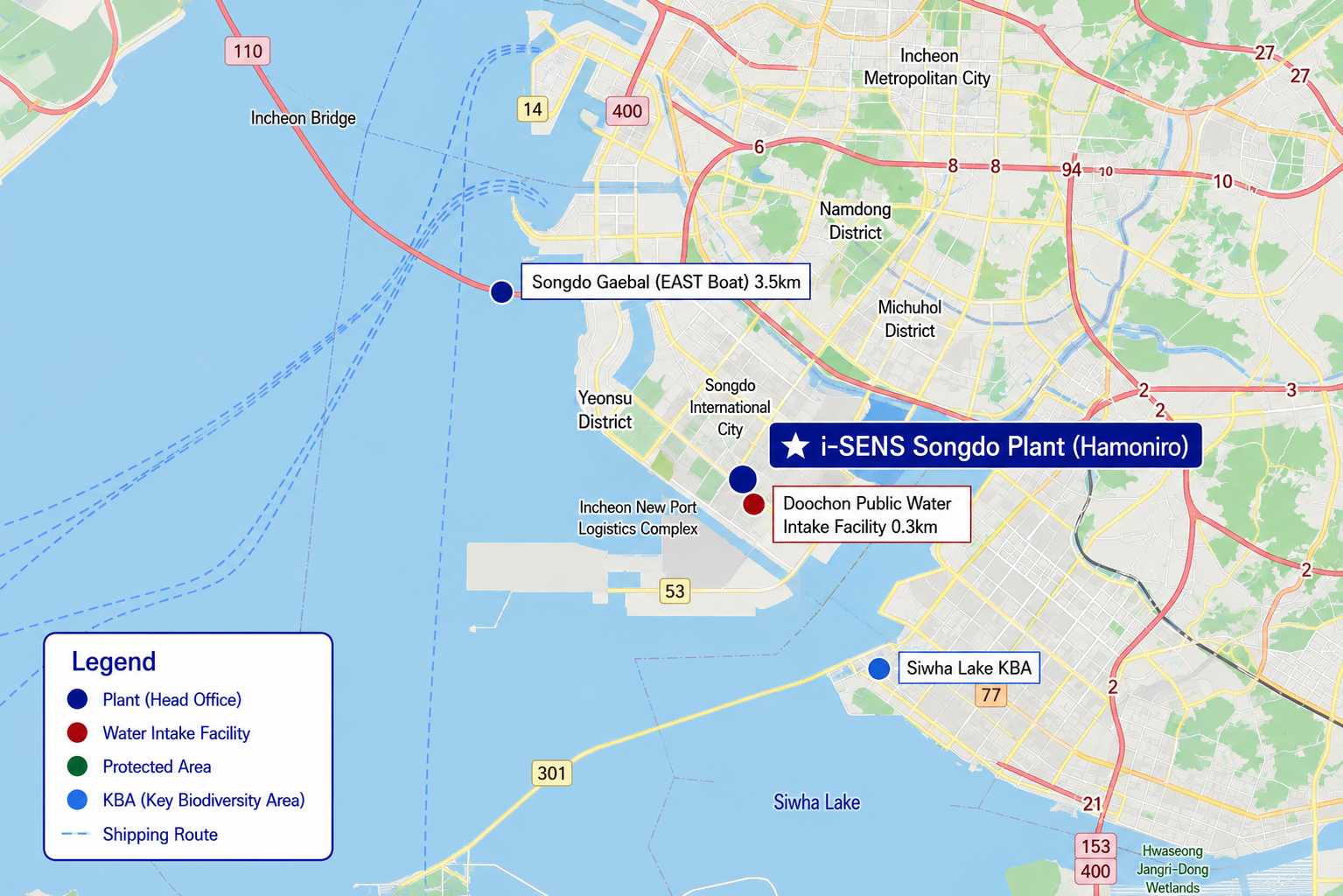
Songdo Plant (Harmony Road) (Yeonsu, Incheon · IVD R&D · Production) — Location sensitivity 4.5/5.0 · priority 65.77 · materiality "Low" · Key adjacencies: red-crowned crane (Class I) 0.49 km, Eurasian oystercatcher (Class II) 0.49 km, white-naped crane (Class II) 0.49 km, Songdo Tidal Flat (Ramsar wetland) 4.1 km, Songdo retention basin wetland 0.28 km
Songdo No. 2 Plant (Incheon Tower-daero) (Yeonsu, Incheon · IVD Production) — Location sensitivity 4.5/5.0 · priority 65.77 · materiality "Low" · Key adjacencies: black-faced spoonbill (Class I) 0.84 km, narrow-mouthed frog (Class II) 0.41 km, Sihwa Lake KBA 5.6 km, Songdo retention basin wetland 0.70 km
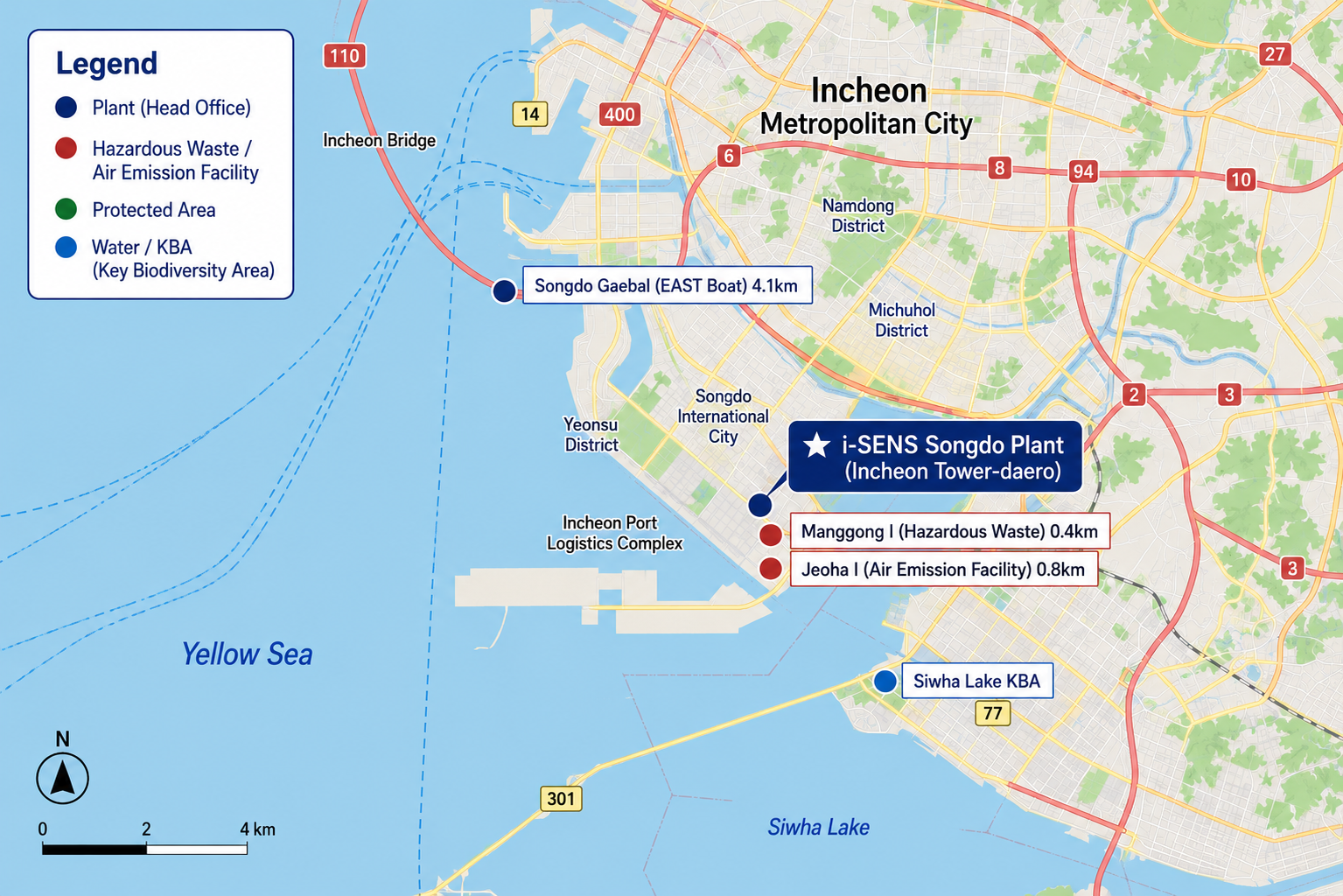
Songdo Detailed Review — Endangered Species Distribution (within 1 km)
In the vicinity of the Songdo Plant and Songdo No. 2 Plant, 7 endangered Class I species (red-crowned crane, black-faced spoonbill, whooper swan, peregrine falcon, white-tailed sea eagle, Chinese egret, oriental stork) and 4 Class II species (narrow-mouthed frog, Eurasian oystercatcher, white-naped crane, Far Eastern curlew) are distributed within 5 km. Class I endangered species such as the red-crowned crane and black-faced spoonbill have been observed within 1 km, confirming the site's position on the West Coast migratory bird flyway.
▲ Limitation: Among the 8 TNFD L4 trigger items, there is no item that directly captures "proximity to endangered species," so Songdo L4 triggering is minimal at 2 items; however, the species score is a perfect 5.0. Therefore, LEAP Assess priority review is based on species score rather than the number of triggers.
Site-by-Site Follow-up Initiatives (Linked to LEAP Assess and Prepare)
Based on the results of this Locate and Evaluate assessment, the Company has identified the following site-specific follow-up initiatives reflecting natural capital sensitivity and impact pathways.
Wonju Plant — Adjacent to a Grade 1 ecological natural map area and assessed as the highest priority among the four sites. Accordingly, wastewater monitoring of the adjacent Seomgang water system is reinforced, and Wonju was selected as the top priority target for the LEAP Assess (risk and opportunity diagnosis) step.
Songdo Plant (Harmony Road) — Located on the West Coast migratory bird flyway, with endangered Class I red-crowned cranes inhabiting within approximately 0.5 km. The Company reviews the potential impact pathway through which wastewater generated in cleanroom processes flows into the adjacent Songdo retention basin wetland.
Songdo No. 2 Plant (Incheon Tower-daero) — Endangered Class I black-faced spoonbills and Class II narrow-mouthed frogs are distributed within 1 km. The Company plans to conduct a biological habitat survey of the site and review cumulative impacts on the adjacent Songdo Tidal Flat.
Seocho Headquarters — Due to its urban location, direct impacts on natural capital are limited; however, the Company reflects the nearby raptor habitat status as location information in the headquarters-level TNFD disclosure.
Overall Conclusion
The materiality of nature-related impacts at the Company's four main business sites was assessed as "Low" across the board, given the nature of the In Vitro Diagnostics (IVD) industry. However, the location sensitivity of the sites is 4.5 to 5.0 out of 5.0 points, corresponding to the upper-middle range among industry peers. The Company does not become complacent with the materiality grade and recognizes natural capital as a key environmental agenda to be managed together with climate change. Accordingly, the Company plans to continue pursuing the LEAP Assess and Prepare steps to concretely identify nature-related risks and opportunities by site, and to progressively expand the application
starting with the Songdo and Wonju sites, which have high location sensitivity. In addition, in line with the TNFD recommendation to apply focused management to locations with high nature dependency and impact ("Priority Location," Strategy D), the Company plans to refine the related disclosure framework and develop initial drafts.
E3-5. Life Cycle Assessment (LCA)
The Company is reviewing the introduction of LCA (Life Cycle Assessment) to quantitatively measure the environmental impacts across the entire life cycle of products — from raw material procurement to production, use, and disposal. Currently, product-level LCA reports are not yet available; the Company plans to apply LCA in phases, starting with the flagship products — blood glucose test strips (BGM) and continuous glucose monitoring sensors (CGM). Meanwhile, for the Magok R&D Center under construction, a preliminary building LCA report has already been prepared (see E3-6), and the Company is progressively expanding the LCA foundation across both product and site dimensions.
4. Eco-Friendly Investment, Procurement, and Sales (E3-6·E3-7·E3-8)
E3-6. Eco-Friendly Investment (2025 Performance)
1. Magok R&D Center Eco-Friendly Certification (scheduled for completion in March 2027)
For the newly constructed Magok R&D Center, the Company has performed eco-friendly certification services from the construction stage, obtaining the Green Building preliminary certification (Excellent · Green Grade 2) and the Building Energy Efficiency Grade preliminary certification (Grade 1) in 2023. The Company aims to obtain the main certifications before completion. The scope of eco-friendly services includes ① preparation and consultation of the energy saving plan (building section), ② preparation of the building energy demand evaluation report, ③ Low Impact Development (LID) preliminary consultation, ④ Green Building preliminary certification (Excellent Grade), ⑤ preparation of the building Life Cycle Assessment (LCA) preliminary report, ⑥ preparation of the road traffic noise prediction report and on-site observation, and ⑦ Building Energy Efficiency Grade preliminary certification (Grade 1).
2. Eco-Friendly Vehicle Transition
The Company is transitioning existing gasoline and diesel sales vehicles to eco-friendly hybrid vehicles. In 2025, four sales vehicles were transitioned to hybrid rentals, with related vehicle costs of approximately KRW 342 million (based on 10 vehicles). Quantitative indicators related to the vehicle transition, including the status of environmentally friendly vehicle holdings, are disclosed in a consolidated manner in 06-1 ESG Performance Data (E6-11).
E3-7. Eco-Friendly Procurement
Quantitative data related to eco-friendly procurement is currently not calculated, and the Company is reviewing the introduction of quantitative indicators in connection with the establishment of an eco-friendly procurement policy.
E3-8. Eco-Friendly Revenue
Quantitative data related to eco-friendly revenue — such as revenue from products designed for fuel efficiency and emissions reduction, and the sales share of recyclable products — has not been calculated as of fiscal year 2025. The Company plans to review the introduction of related indicators when an eco-friendly revenue classification system is established in the future.
5. Certifications, Initiatives, and Contributions (E3-9·E3-10·E3-11)
E3-9. Third-Party Eco-Friendly Certification
The Company has obtained and maintains certification under ISO 14001, the international standard for environmental management systems. The current certification is valid from October 10, 2025 to August 23, 2028, and the certificate has been submitted.
E3-10. Environmental Initiative Participation and Activities
1. Carbon Emissions Measurement and Management
The Company calculates greenhouse gas emissions (Scope 1·2) by site and establishes and manages reduction targets. In 2025, the disaggregation of emissions at four business sites (Headquarters, Wonju, Songdo, Songdo No. 2) was completed, and based on this, reduction activities for carbon neutrality implementation are being pursued. Specific emissions and performance against targets are disclosed in 06-1 ESG Performance Data (E6-5 to E6-8) and the 06-9 TCFD Index.
2. Global-Level Diagnostics
The Company is regularly diagnosed on its level of environmental management by EcoVadis and domestic ESG assessment institutions, and reflects the improvement initiatives identified through such diagnostics into environmental management goals for management.
E3-11. Eco-Friendly Community Contribution Activities
Quantitative results for eco-friendly community contribution activities are not currently calculated separately. The Company plans to separately manage the eco-friendly component when refining the community contribution activity classification system going forward.
6. Compliance with Laws and Regulations (E3-12)
E3-12. Environmental Legal Violation Status (2024)
1. Environmental Legal Violation — 2024
During an inspection of the Wonju Plant by the Wonju Regional Environmental Office in 2024, it was confirmed that some pollutants subject to atmospheric emission facility change reporting were not reflected in the permit. As a result, the Company was fined KRW 600,000 for failure to perform change reporting under Article 23 of the Clean Air Conservation Act. Although this matter falls within the reporting period of the 2024 Sustainability Report, it was not finally reflected in the report at the time of preparation due to the procedure for compiling and reviewing the status of environmental law violations, and therefore was not included in the report.
2. Recurrence Prevention Measures — Follow-up Actions
After confirming the relevant fact, the Company conducted a full investigation of air pollutants and reflected the unreported items — dust, hydrogen chloride, and formaldehyde — in the permit. The Company also operates semi-annual self-measurement and reporting procedures to the competent environmental office, and is strengthening verification procedures and final inspection systems among relevant departments so that major ESG reporting items — including environmental legal violations, administrative dispositions, and changes to permits — are accurately reflected at the Sustainability Report preparation stage.