

UN SDGs Implementation and Progress Communication
1. Contribution to the UN Sustainable Development Goals (UN SDGs)
The Company adopts the United Nations Sustainable Development Goals (UN SDGs) as a core standard of management. Based on core technologies including the blood glucose meter, continuous glucose monitor, and Point-of-Care Testing (POCT) systems, the Company contributes to improving healthy lives and medical accessibility for people worldwide, directly responding to Good Health and Well-Being (Goal 3). Furthermore, the Company contributes to the achievement of multiple goals, including Decent Work and Economic Growth (Goal 8), Industry, Innovation, and Infrastructure (Goal 9), Responsible Consumption and Production (Goal 12), Climate Action (Goal 13), and Partnerships for the Goals (Goal 17). In particular, by strengthening sustainable manufacturing systems through eco-friendly production processes, energy efficiency improvement, and waste reduction, the Company practices Responsible Consumption and Production (Goal 12). As a member of the United Nations Global Compact (UNGC), the Company annually reports its UN SDGs-related progress and achievements through its Communication on Progress (CoP). In addition, centered on the ESG governing body and ESG Task Force operated by the Ethics Management Office, SDG goals and KPIs are set by each department, and annual performance is reviewed and the results transparently shared with stakeholders. Going forward, the Company plans to manage SDG implementation performance quantitatively and strengthen the linkage between business performance and social value creation, contributing to sustainable growth and the development of the global healthcare industry.
2. Key Activities and SDG Mapping
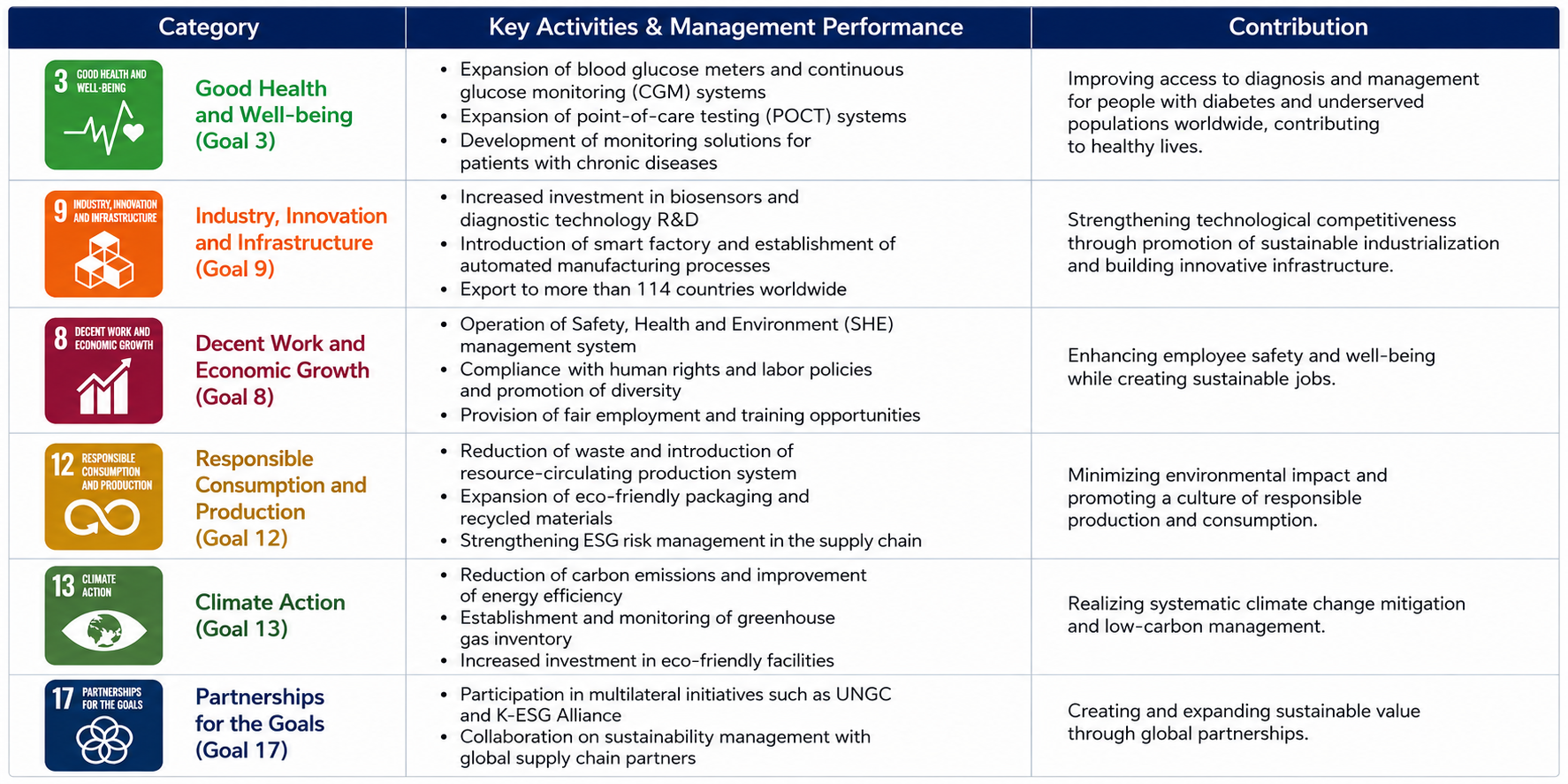
Indirect Contribution — 11 Goals (Qualitative Disclosure)
· Goal 1 (No Poverty) → 04-6 Community Investment (free provision of blood glucose meters to medically underserved populations)
· Goal 2 (Zero Hunger) → 04-5 Supply Chain (food safety supplier management) — indirect
· Goal 4 (Quality Education) → 04-2 Human Resources (employee training and industry-academia cooperation) · 04-6 Community Investment(training for medical professionals and academic society sponsorship)
· Goal 5 (Gender Equality) → 04-2 Human Resources · 05-1 Governance (proportion of female directors and executives)
· Goal 6 (Clean Water and Sanitation) → 03-4 Water Resources (water usage and reuse rate)
· Goal 7 (Affordable and Clean Energy) → 03-2 Climate · TCFD (renewable energy transition roadmap)
· Goal 10 (Reduced Inequalities) → 04-4 Human Rights Management (wage gap · DEI) · 04-6 Community Investment(medical accessibility)
· Goal 11 (Sustainable Cities) → 04-6 Community Investment(cooperation with Wonju and Songdo communities)
· Goal 14 (Life Below Water) → 03-1 Environmental Management · 03-3 EU Packaging and Packaging Waste Regulation (PPWR) (microplastic reduction)
· Goal 15 (Life on Land) → 03-1 §6 Biodiversity Policy (preemptively established in 2025) · 06-9 TNFD Index
· Goal 16 (Peace, Justice and Strong Institutions) → 05-2 Ethics Management · 05-1 Governance (anti-corruption · Board independence)
Direct Quantitative Disclosure — 6 Goals
· Goal 3 (Good Health and Well-Being) → 04-1 Patient Safety · 04-6 Community Investment(KPI: number of recalls · patient accessibility)
· Goal 8 (Decent Work) → 04-2 Human Resources · 04-3 Health & Safety · 04-4 Human Rights Management (KPI: voluntary turnover rate · LTIFR)
· Goal 9 (Industry, Innovation, Infrastructure) → 01-4 Business · 03-5 Eco-Friendly Products (KPI: R&D investment ratio · number of export countries)
· Goal 12 (Responsible Consumption and Production) → 03-3 Resource Circulation · EU PPWR · 04-5 Supply Chain (KPI: waste recycling rate · supply chain ESG evaluation rate)
· Goal 13 (Climate Action) → 03-2 Climate · TCFD (KPI: Scope 1·2 emissions · GHG intensity)
· Goal 17 (Partnerships) → 04-5 Supply Chain · 04-6 Community Investment· 05-2 Ethics Management (KPI: UNGC CoP submission · cases of cooperation with patient associations)
This report directly addresses 6 SDGs (Goals 3, 8, 9, 12, 13, 17) through quantitative KPIs, while the remaining 11 are addressed through indirect contribution or qualitative disclosure in the body text. In accordance with the AA1000AP Inclusivity principle, the body chapter mapping and contribution level for all 17 SDGs is disclosed as follows.
3. SDGs Progress Communication and Management System
The Company sets key goals and KPIs for each SDG centered on the Sustainability Committee(chaired by Ethics & Compliance Office, and reviews and reports progress at least once a year. The results are transparently disclosed to stakeholders through the UNGC Communication on Progress (CoP) and the Sustainability Report.