Materiality Assessment
What is Double Materiality?
Double Materiality is a core concept introduced by the EU Corporate Sustainability Reporting Directive (CSRD), and is an approach that simultaneously assesses impacts in two directions. One is the impact of the company on the environment and society (Impact Materiality), and the other is the impact of environmental and social issues on the company's financial performance (Financial Materiality). In other words, it is a methodology that derives key issues by jointly examining the two perspectives — "i-SENS’ impacts on people and the environment and the sustainability-related financial risks and opportunities affecting i-SENS from the outside world."
In 2025, the Company introduced a Double Materiality Assessment (DMA) based on the CSRD. A total of 221 participants — 28 external stakeholders and 193 internal employees — evaluated 34 ESG issues, and the 9 issues that were significant on both the Impact Materiality and Financial Materiality axes (dual-material issues) were confirmed as the key reporting issues.
1. Overview
This chapter covers the results of the Double Materiality Assessment for the 2025 reporting period, in accordance with EU ESRS 1 (3.4). The Company has fully transitioned from the single materiality (GRI-based) approach used in the previous report (2024) to the Double Materiality approach, and conducted the assessment based on procedures aligned with EFRAG Implementation Guidance 1 (2024) and the materiality concept of the ISSB.
2. Assessment Methodology — 4-Step Procedure
The Company derived key issues through the following four-step procedure.
Step 1 · Issue Pool Composition — Comprehensively considering GRI Standards 2021, the SASB Medical Equipment standard, ESRS topic standards, the previous single materiality assessment results, and benchmarks from global industry peers (Dexcom, Abbott, Roche), a total of 34 issues for evaluation were selected — 10 environmental, 13 social, and 11 governance.
Step 2 · Impact Materiality Assessment (Form A · External) — A total of 28 external stakeholders, including suppliers, institutional investors, and customers, participated in the assessment. Group-level averages were calculated, and equal weights (1/3 each) were assigned to the three groups.
Step 3 · Financial Materiality Assessment (Form B · Internal) — A total of 193 internal employees, consisting of management, team leaders, and general employees, participated in the assessment, with a simple average applied.
Step 4 · Prioritization — Issues that simultaneously met the thresholds of Impact Materiality ≥ 7.07 and Financial Materiality ≥ 8.51 were determined as key issues.
2-1. Assessment Process
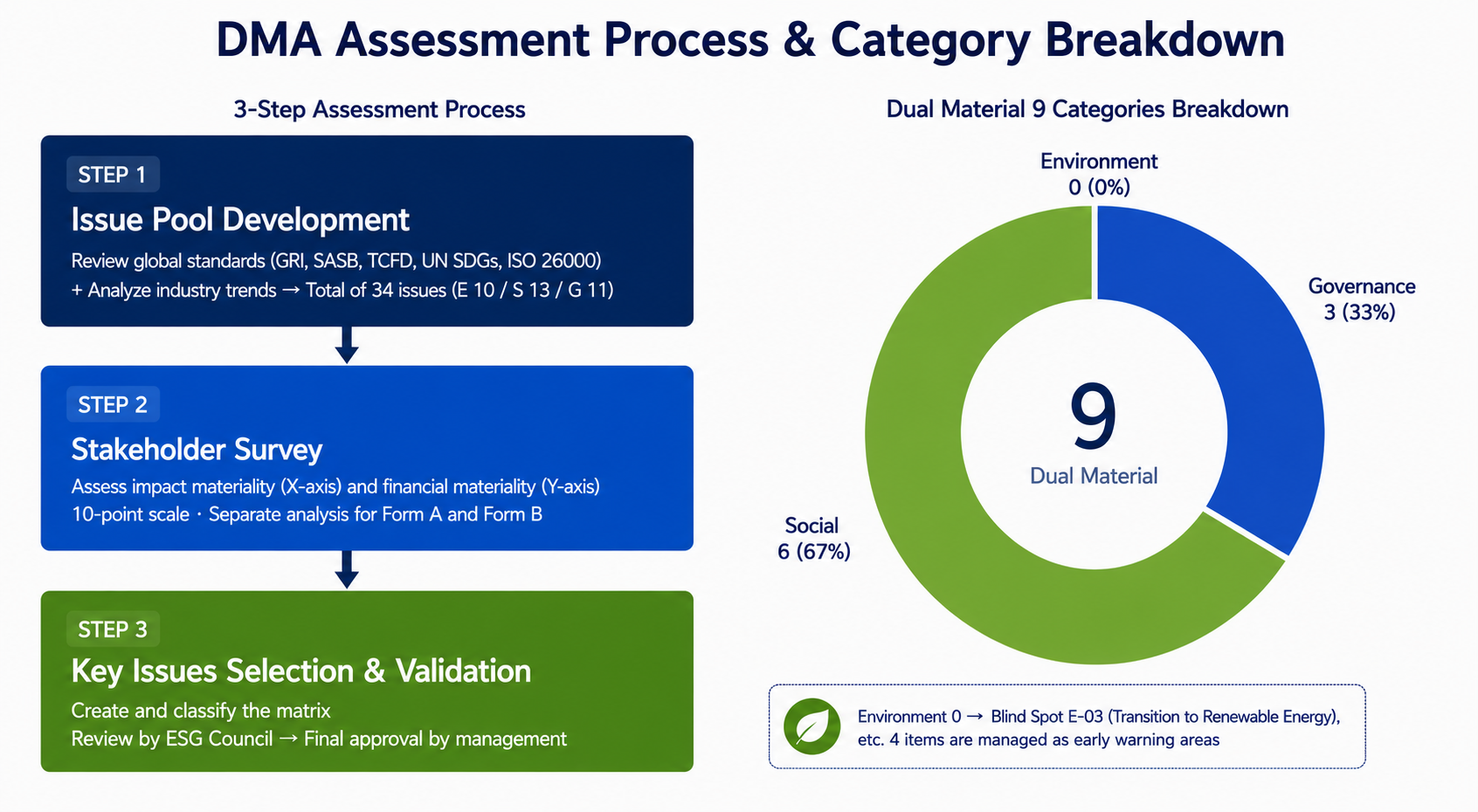
▲ Issue Pool Composition → Stakeholder Survey → Key Issue Selection and Verification / Distribution by area for the 9 Dual Material issues: Social 6 · Governance 3 · Environmental 0
· The 3-step process here is an externally-facing condensed visualization of the 4-step procedure (issue pool → Impact Materiality → Financial Materiality → prioritization) described in §2 of the body text. Both representations refer to the same procedure.
2-2. Assessment Criteria
GRI 3 (2021) Material Topics · ESRS 1 3.4 Double Materiality · AA1000SES Stakeholder Engagement Standard, applied in parallel. Thresholds (on a 10-point scale): Impact Materiality ≥ 7.07 / Financial Materiality ≥ 8.51.
3. Respondent Composition
External: Suppliers 14 (50%) + Institutional Investors 8 (28.6%) + Customers 6 (21.4%) = 28 persons
Internal: Management 2 (1.0%) + Team Leaders 30 (15.5%) + General 161 (83.4%) = 193 persons
Valid responses: total 221 persons; 30 unfaithful responses fully removed.
7 stakeholder groups (aligned with AA1000SES 2015): ① Employees (management, team leaders, general) · ② Suppliers (Tier 1 trading partners) · ③ Customers (LifeScan and other global OEM/ODM partners) · ④ Institutional investors and analysts · ⑤ Patients and patient associations (Korea Type 1 Diabetes Patient Association and others — see body sections 04-1, 04-6 of this report for cooperation channels) · ⑥ Medical professionals and academic societies (Korean Diabetes Association, etc.) · ⑦ Regulators and policy (Ministry of Food and Drug Safety, FDA, EU Notified Bodies, NHIS). The 28 external and 193 internal survey participants are concentrated in groups ① to ④, while groups ⑤ to ⑦ are reflected in body chapters of this report through qualitative interviews and indirect data.
3-1. Respondent Distribution (Visualized)
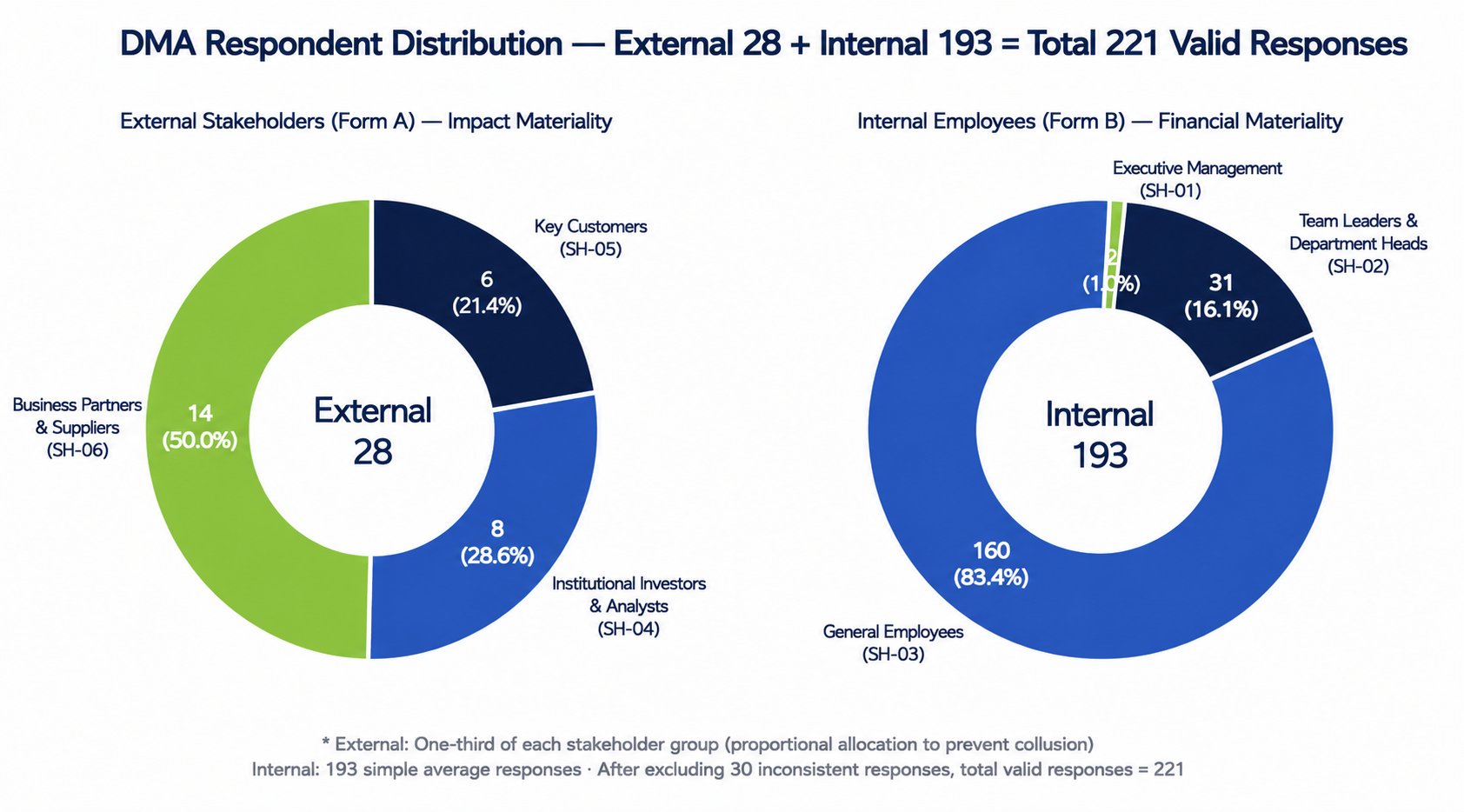
▲ 28 external stakeholders + 193 internal employees = total 221 valid responses · covering 7 stakeholder groups
4. Double Materiality Matrix
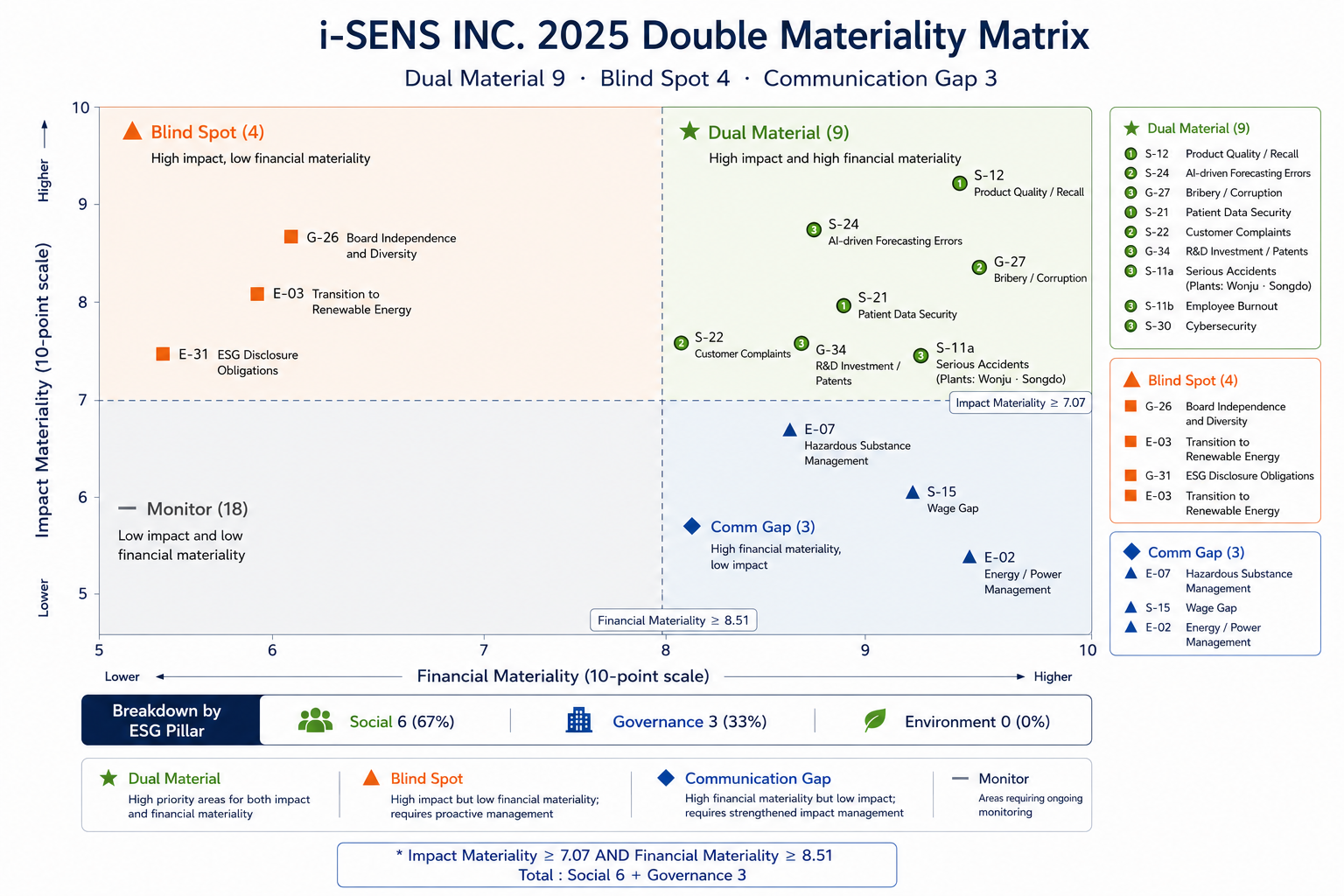
▲ X-axis Impact Materiality threshold 7.07 · Y-axis Financial Materiality threshold 8.51 (10-point scale) — the upper-right quadrant is the Dual Material area
5. Results — Materiality Map, 4 Quadrants
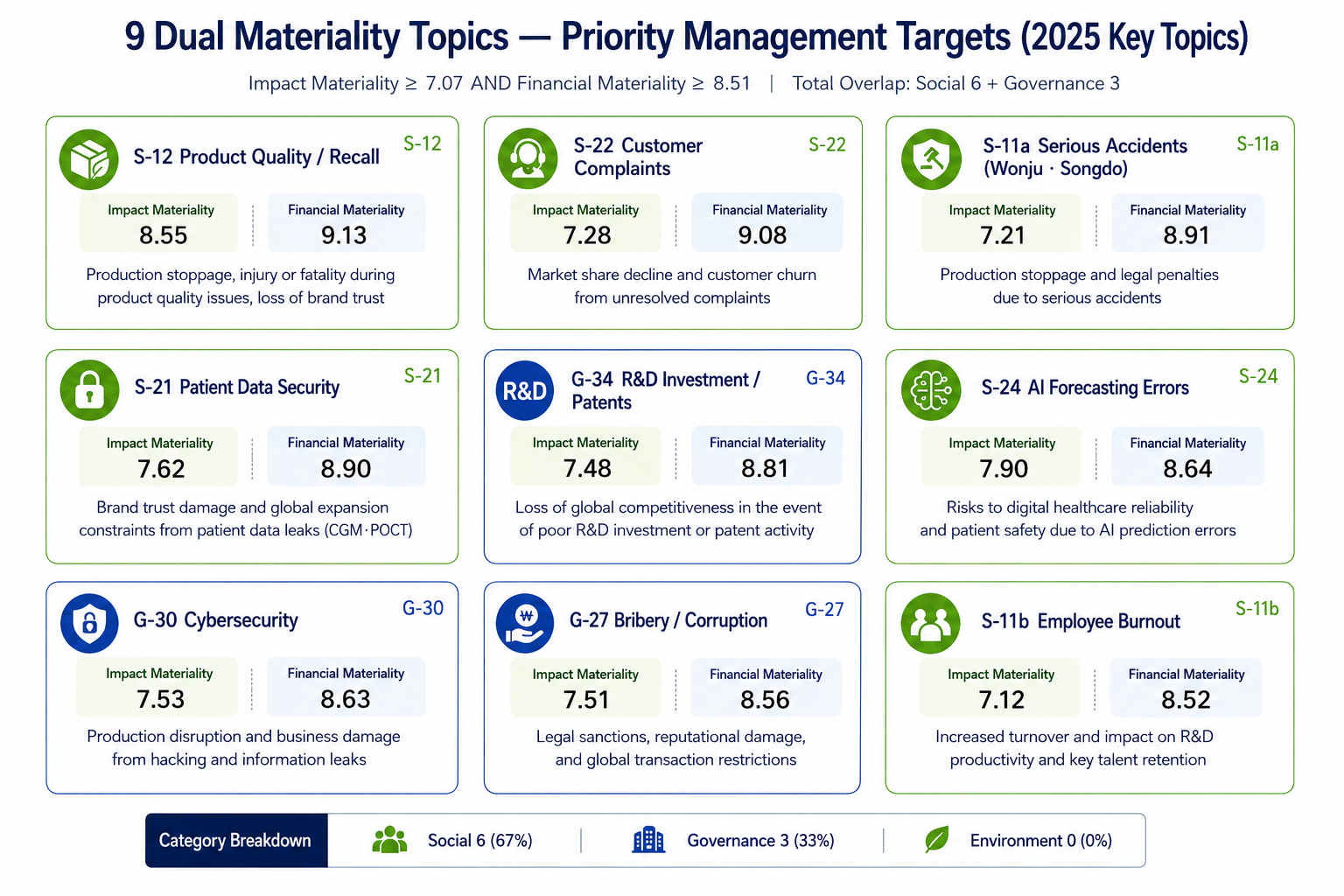
★ Dual Material 9 issues: S-12 Product defect/recall · S-21 Patient data security · S-24 AI glucose prediction · S-22 Customer complaints · G-34 R&D/patents · G-30 Cybersecurity · S-11a Serious accidents · G-27 Corruption/bribery · S-11b Employee burnout
⚠ Blind Spot 4: G-33 Long-term growth/local hiring · G-26 Board independence/diversity · E-03 Renewable energy · G-31 ESG disclosure obligations
Communication Gap 3: E-02 Energy and electricity · S-15 Wage gap · E-07 Chemical substance management
— Monitoring 18
5-1. DMA Key Results Summary (Visualized)
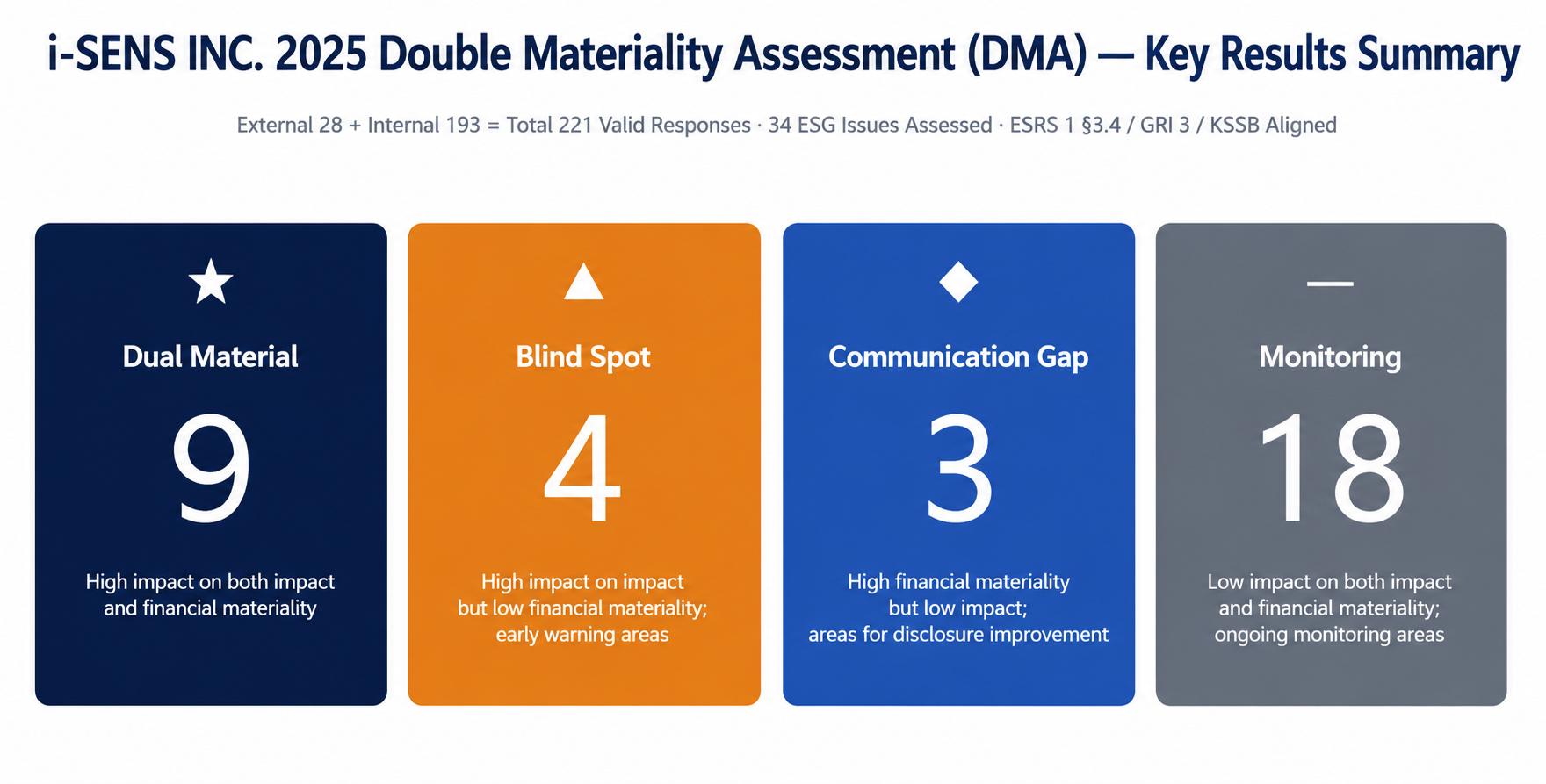
▲ Result of classifying 34 issues into 4 quadrants: Dual Material 9 · Blind Spot 4 · Communication Gap 3 · Monitor 18
6. Dual-material 9 Key Issues
▲ Rank 1: S-12 Product defect/recall (Impact 8.55 / Financial 9.13) — reflecting the identity as a medical device company · Social 6 / Governance 3 / Environmental 0
Dual Material 9 — 1:1 mapping to body chapters (AA1000AP Responsiveness Principle)
Rank 1: S-12 Product defect/recall (8.55 / 9.13) → 04-1 Patient Safety · GRI 416 · KPI: Number of recalls
Rank 2: S-21 Patient data security (7.62 / 8.90) → 05-4 Information Security + 04-1 · GRI 418 · KPI: Personal information breaches
Rank 3: S-24 AI glucose prediction error (7.90 / 8.64) → 05-5 AI Ethics + 04-1 · GRI 416 · KPI: AI accuracy
Rank 4: S-22 Customer complaint response (7.28 / 9.08) → 04-1 · GRI 416 · KPI: Claim handling time
Rank 5: G-34 R&D investment/patents (7.48 / 8.81) → 01-4 Business + 05-3 Risk · GRI 203 · KPI: R&D ratio
Rank 6: G-30 Cybersecurity (7.53 / 8.63) → 05-4 · GRI 418 · KPI: Number of breaches
Rank 7: S-11a Serious accidents (Wonju, Songdo) (7.21 / 8.91) → 04-3 Health & Safety · GRI 403 · KPI: LTIFR
Rank 8: G-27 Corruption/bribery (7.51 / 8.56) → 05-2 Ethics Management · GRI 205 · KPI: Ethics training completion rate
Rank 9: S-11b Employee burnout (7.12 / 8.52) → 04-2 Human Resources Management · GRI 401 · KPI: EAP utilization rate
7. Comparison with the Previous (2024) Assessment Results
2024 Single Materiality: 32 external · 192 internal · 30 issues · 6 key issue areas identified — "Product safety and quality" (4.56 points) ranked top
2025 Double Materiality: 28 external · 193 internal · 34 issues · Dual Material 9 + Blind Spot 4 + Communication Gap 3 + Monitoring 18
Reason for change: Application of ESRS 1 3.4; alignment with EFRAG IG 1 (2024)
Changes in the List of Material Topics (GRI 3-2-b)
As a result of the 2025 Double Materiality Assessment, the list of material topics changed as follows compared to the 6 key issue areas identified in the previous (2024) single materiality assessment.
2024 Key Issues (6 Areas) | 2025 Assessment Results | Type of Change |
Product Safety and Quality Management | S-12 Product defect/recall · S-22 Customer complaint response (Dual Material) | Maintained and subdivided — top-ranked in both years |
R&D and Technological Innovation | G-34 R&D investment/patents (Dual Material) | Maintained |
Talent Acquisition and Retention | S-11b Employee burnout (Dual Material) | Maintained and redefined |
Climate Change Response | E-03 Renewable energy transition (Blind Spot) | Reclassified — meets Impact Materiality but below Financial threshold |
Resource Efficiency and Circular Economy | E-02 Energy and electricity dependence · E-07 Chemical substance management (Communication Gap) | Reclassified — managed as enhanced-disclosure area |
Supply Chain ESG Management | Monitoring | Reclassified — continued observation |
There are 5 newly entering topics in 2025. S-21 Patient data security, S-24 AI glucose prediction error, and G-30 Cybersecurity newly emerged due to the expansion of the CGM business (S-24 was newly added to the issue pool); G-27 Corruption/bribery and S-11a Serious accidents were not included in the key areas of the previous assessment but met the threshold on both axes in the Double Materiality Assessment.
The reasons for the changes are three: ① Methodology shift — upgraded from single materiality (single 5-point axis) to Double Materiality (two axes: impact and financial) in accordance with ESRS 1 §3.4 and EFRAG IG 1 (2024); ② Issue pool reconfiguration — expanded from 30 to 34 issues by reflecting medical device industry-specific issues (AI, patient data, etc.); ③ Introduction of threshold-based four-quadrant classification — separately identifying Blind Spot and Communication Gap in addition to key issues.
However, since the scales and methodologies of the two-year assessments differ, direct comparison of scores is not appropriate. Reclassified areas are not disclosure-terminated but continue to be managed via the Blind Spot (proactive management), Communication Gap (enhanced disclosure), and Monitoring (continued observation) frameworks.