

Sustainability — SENSE for LIFE
Built on the foundation of integrity management, i-SENS embraces ESG not as a mere slogan but as an integral part of daily operations. We are advancing as a medical device leader that responds responsibly to the signals from our patients, society, and the planet. This chapter details our ESG governance framework, the structure and decisions of our Sustainability Council, our core policy areas, and the outcomes of our external sustainability assessments.
1. Sustainability Governance
The Company manages its sustainability initiatives through a structured, three-tier governance system: the Board of Directors at the apex, the ESG Council as the central deliberative node, and the ESG Task Force handling operational execution. The Board of Directors holds ultimate oversight, reviewing and approving material impacts, risks, and opportunities (IROs) regarding the economy, the environment, and human rights. The Board also bears final responsibility for ensuring the reliability and appropriate disclosure of the Sustainability Report.
The ESG Council, chaired by the CEO with the Ethics Management Office serving as the secretariat, deliberates on impact assessment results and improvement initiatives. The Council reports its findings quarterly to the Board of Directors, ensuring seamless alignment and oversight. Operational execution is driven by the ESG Task Force, which manages specific Key Performance Indicators (KPIs) across seven functional teams (HR/General Affairs, Safety Management, Production Management, SCM, IT, Marketing, and Management Planning). This governance structure is further reinforced by a six-step responsible-management due diligence process aligned with the OECD Guidelines for Multinational Enterprises and the UN Guiding Principles on Business and Human Rights. Furthermore, executive compensation is strategically linked to sustainability performance indicators, and all ESG risk management processes are objectively verified through independent consulting by Korea ESG Credit, an external ESG specialist organization.
[Figure 1-1] i-SENS ESG Governance Structure
2. Sustainability Council
The ESG Council serves as the Company's highest deliberative body for reviewing and deciding ESG strategic directions and material IROs, bridging the Board of Directors and the operational Task Force.
2.1 Launch and Composition
The ESG Council was officially launched on February 2, 2024. It is composed of one Chair and six division-specific expert members, covering six core functions of the Company: R&D, Production, Finance, Management Planning, Legal, and Sales. This composition allows ESG matters to be judged from multiple expert perspectives rather than being biased toward any single department.
Category | Position | Area of Expertise |
Chair | Hak-Hyun Nam (CEO) | General Management |
Member | Bong-Gyun Oh (CTO) | R&D |
Member | Hyun-Jun Oh (CPO) | Production and Quality Management |
Member | Sang-Do Ahn (CCO) | Sales Management |
Member | Jong-Woo Yoon (CFO) | Financial Management |
Member | Director. Deok-Ha Hwang | Management Planning |
Member | Office Head. Jae-Myung Ryu | Compliance / Internal Control |
2.2 Secretariat and Operational Support Organization
The secretariat of the ESG Council is led by the Ethics Management Office. The secretariat reviews agenda items in advance, manages minutes, and operates the reporting line through which the Council's discussion results are transmitted to the Board of Directors. The supporting body for execution is the ESG Task Force (operational). It consists of 7 teams — the HR & General Affairs Team, Safety Management Team, Production Management Team, SCM Team, IT Team, Marketing Team, and Management Planning Team — collecting quantitative performance indicators (KPIs), providing data needed for impact assessments, and executing the items decided by the Council in actual operations.
2.3 Meeting Operations, Authority, and Agenda
The ESG Council holds two regular meetings annually by default, with ad hoc meetings convened as material issues arise. The principal authority and agenda items addressed by the Council include:
1. Reviewing semi-annual ESG performance and determining the next strategy.
2. Determining ESG disclosure and external communication items (Sustainability Report, corporate website, EcoVadis response, etc.).
3. Determining ESG-related corporate rules and policies (including Double Materiality Assessment results).
4. Prioritizing material impacts, risks, and opportunities (IROs) and designating responsible departments.
2.4 Reporting to the Board of Directors
The Council's operating results and key internal control matters are reported to the Board of Directors via the following framework.
Reporting Item | Reporting Cycle |
Internal Accounting Control System Operating Evaluation Results | Annual regular reporting |
Health and Safety Plan and Operational Evaluation | Reported as needed |
Information Security and IT System Controls | Reported as needed |
2.5 Performance Evaluation and Independent External Advisory
The Board of Directors and the ESG Council receive reports from responsible departments on how the Company's management activities affect the economy, environment, and people (human rights), then review and decide on issues requiring improvement. The adequacy of ESG risks and improvement activities is not relied upon based solely on the Company's internal judgment, but is objectively reviewed through independent consulting and evaluation by Korea ESG Credit, an external ESG specialist organization. Results are reported to the Board of Directors as necessary and reflected in governance decisions and the following year's ESG strategy and execution plan.
Major Sustainability Deliberations and Decisions (2025)
The Company holds two regular meetings annually and convenes ad hoc meetings as necessary to discuss and decide on key ESG matters.
[2025 ESG Council Activities by Session]
1st Meeting | 2nd Meeting | |
Date | Thursday, February 20, 2025 | Tuesday, April 22, 2025 |
Venue | 3rd Floor Meeting Room, i-SENS Headquarters | |
Attendees | Chair: CEO Hak-Hyun Nam | |
Key Agenda | Establishing the 2025 ESG direction and global ESG regulatory response strategy | Presentation, discussion, and confirmation of Double Materiality Assessment (DMA) results; approval of five priority strategies; and assignment of departmental KPIs |
Key Content | Presentation of 2025 key ESG strategies · 2025 ESG trends, including regulatory trends in the U.S., EU, China, and Japan · Report on 2024 performance, including KCGS B rating and EcoVadis Silver rating · Identification of improvement tasks · Five priority initiatives for 2025 · Action plans across 11 areas | Report on Double Materiality Assessment results · Stakeholder survey results covering employees, distributors, and consumers · Identification of nine material issues through the DMA · Approval of five priority strategies · Assignment of KPIs to responsible departments by area |
Process | Preliminary analysis and review by the secretariat → External advisory verification → Committee deliberation and resolution → Delegation to departments, with execution assigned to the ESG Task Force | |
Sustainability Task Force (Operational) Activities
i-SENS' ESG Task Force (operational) consists of the Ethics Management Office secretariat and 7 departments (HR, Safety Management, Production Management, SCM, IT, etc.), operating on a monthly regular basis. Its main role is executing items resolved by the ESG Council in actual operations, managing quantitative performance indicators (KPIs), and responding to external assessments. In 2025, a total of 11 meetings were held. In the first half, the Task Force focused on building the foundation of ESG operations. First, it closed out 2024 performance and confirmed 2025 MBO site-level targets (Session 25-2, March), then conducted preliminary review for the 2nd Council meeting while deriving the 9 issues from the Double Materiality Assessment (DMA) (Session 25-3, April). The Task Force also conducted the first-half supplier ESG evaluation for 10 companies (Session 25-4, May) and completed preparations for ISO 14001 recertification (Session 25-5, June). In the second half, focus shifted to responding to external assessments. To prepare for the EcoVadis assessment, the Task Force conducted focused training for three consecutive months from September to November (Sessions 25-6, 25-7, 25-8), and during the reporting of the KCGS 2025 assessment results, confirmed that the integrated rating advanced one notch from B to B+. At year-end in December, the Task Force completed the annual environmental management settlement and pre-organized the agenda items to be pursued in 2026 (Sessions 25-10, 25-11).
Session | Date | Key Agenda | Method |
25-1 | 2025-01 | · Closing of 2024 ESG data · Prior agreement on 2025 departmental KPIs · Preliminary preparation of the agenda for the 1st ESG Council meeting on February 20 | Review of departmental KPI drafts → Submission to the ESG Council |
25-2 | 2025-03 | · 2024 performance and improvement tasks · Sharing of five priority initiatives for 2025 · Confirmation of 2025 MBO site-level targets for Scope 1+2, waste, and water | Dissemination of ESG Council resolutions → Allocation of targets by site |
25-3 | 2025-04 | · Preliminary review of the agenda for the 2nd ESG Council meeting on April 22 · Identification of nine issues through the Double Materiality Assessment (DMA) | Stakeholder survey analysis → Preparation of the DMA matrix |
25-4 | 2025-05 | · First-half supplier ESG evaluation for 10 companies through document-based due diligence · Conflict minerals (3TG) monitoring · Collection of human rights impact assessment data | Application of the IS-ESG-SC process → Supplier scoring |
25-5 | 2025-06 | · First-half SHE inspection (ISO 45001) · Preliminary preparation for ISO 14001 recertification | Aggregation of site-level safety incident and environmental data |
25-6 | 2025-09 | EcoVadis assessment response training | Review of key sustainability issues in the medical device industry, four assessment axes, and EcoVadis scoring criteria |
25-7 | 2025-10 | EcoVadis kickoff meeting | Confirmation of four assessment response practices and agreement on the assessment response execution plan |
25-8 | 2025-11 | EcoVadis assessment response 2 | Verification of certificate validity, consistency check of Q&A and evidence, and prioritization of 55 evidence documents |
25-9 | 2025-11 | KCGS 2025 evaluation result report | Comparison of 2024 and 2025 scores and review of improvement areas following the rating change |
25-10 | 2025-12 | Environmental management performance evaluation | Year-end settlement of environmental KPIs and review of annual environmental management performance |
3. SENSE for LIFE — Sustainability Management System
As a company whose core business is "Sensing," the Company defines its ESG philosophy as SENSE for LIFE — going beyond sensing patients' vital signs to also sensing the signals of the Earth, people, and trust, and aspiring to become "a responsible medical device company for life."
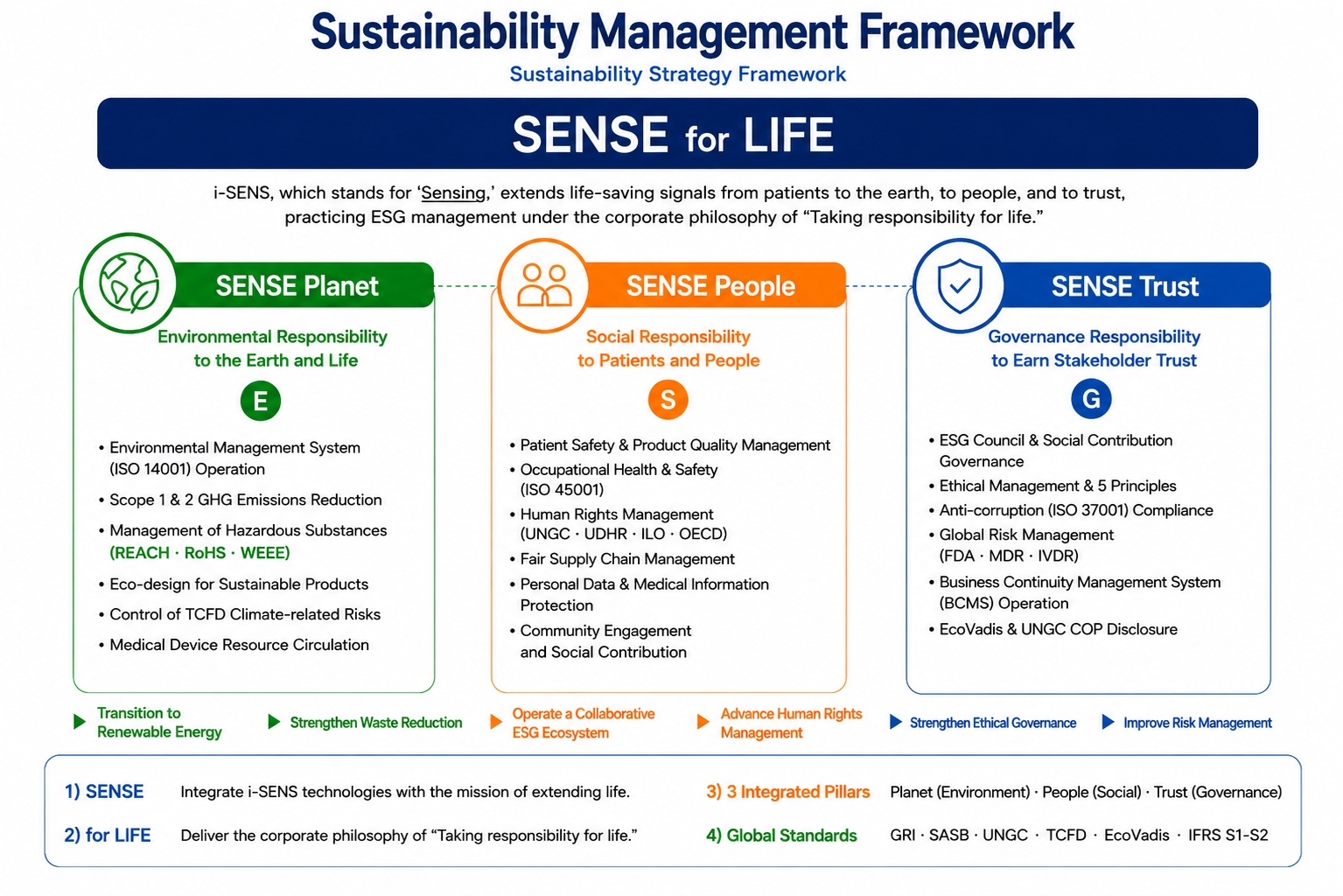
[Figure 3-1] SENSE for LIFE Sustainability Management Strategy Framework (Planet · People · Trust 3 Axes)
SENSE Planet — Environmental Responsibility that Senses the Earth and Life (E)
The Company operates an Environmental Management System (ISO 14001) and systematically manages its environmental responsibility. It calculates and reduces direct and indirect greenhouse gas (Scope 1·2) emissions from its sites and manages hazardous substances that may be contained in medical devices in accordance with international standards (REACH·RoHS·WEEE). The Company also reviews climate change risks based on the TCFD, safely treats medical waste while maintaining a system for circulating waste resources, and applies Eco-design that considers the environment from the product design stage. Going forward, the Company plans to establish a renewable energy transition roadmap and intensify waste reduction activities as key initiatives.
SENSE People — Social Responsibility that Senses the Health of Customers and Patients (S)
The Company pursues quality management with patient safety as the top priority and operates an Occupational Health and Safety Management System (ISO 45001) to create a safe working environment for employees. Human rights management is practiced based on international norms including the Universal Declaration of Human Rights (UDHR), the United Nations Global Compact (UNGC), the International Labour Organization (ILO), and OECD standards, and ESG evaluation and due diligence are conducted on the supply chain. In addition, the Company devotes efforts to information security and the protection of personal medical information, and continues healthcare contribution activities for local communities. Key initiatives include the operation of the supplier ESG evaluation system and the practice of human rights management.
SENSE Trust — Governance that Senses Stakeholder Trust (G)
The Company operates responsible governance through the ESG governing body and Board of Directors oversight system, and practices trustworthy management based on integrity management and the five principles of the Ethics Charter. To support this, the Company operates international management systems including anti-bribery (ISO 37001), compliance (ISO 37301), information security (ISO 27001), and business continuity (ISO 22301, BCMS). It also complies with global regulations in the medical device field (FDA, MDR, IVDR) and transparently discloses these activities through EcoVadis and the UNGC Communication on Progress (CoP). Key initiatives going forward are further strengthening ethics management and advancing the risk management system.
4. Sustainability Key Policies — 5 Areas
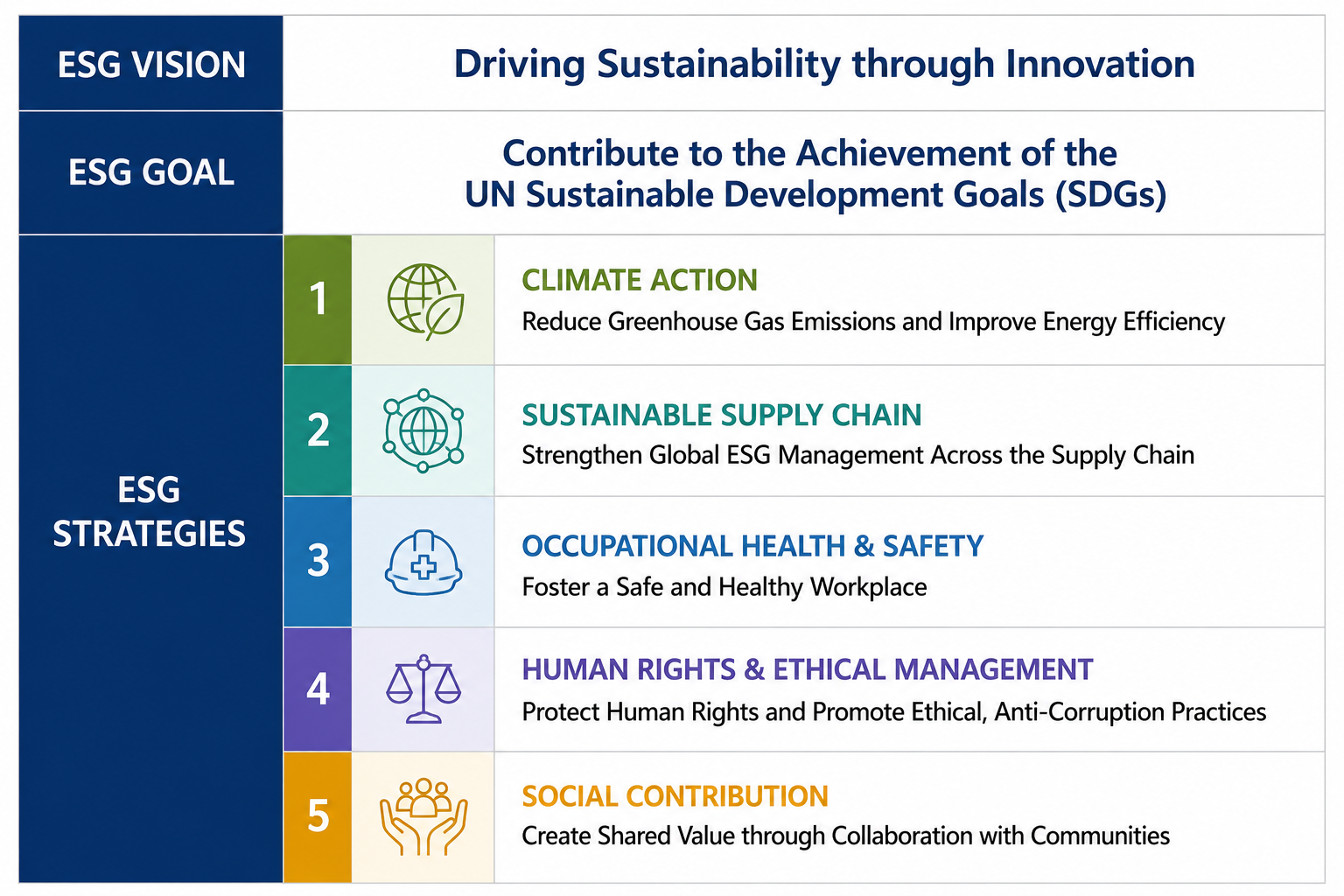
The Company pursues ESG management across five strategic directions. Centered on ESG management, the Company practices responsibility through specific activities across safety, health and environment; ethics and compliance; sustainable supply chain; human rights; and community contribution, as follows:
Strategic Direction | Key Activities |
Safety, Health & Environmental Management | Promote a safe workplace culture and improve products and services through eco-friendly and low-carbon transition. |
Ethics & Compliance Management | Refrain from unfair trade and corrupt practices, practice integrity management, and protect trade secrets and personal information through information security policies. |
Sustainable Supply Chain | Manage the supply chain sustainably and fully prohibit the use of minerals mined from conflict-affected areas. |
Human Rights Management | Comply with global human rights standards, including diversity, non-discrimination, and protection of children's rights, and protect the human rights of employees, customers, and stakeholders. |
Community Contribution | Carry out community contribution activities in areas such as regional revitalization, talent development, environmental protection, support for vulnerable groups, and culture and arts sponsorship. |
5. Safety · Health · Environment (SHE) Policy
Based on five management principles for safety, health, and environment, the Company operates the Occupational Health and Safety Management System (ISO 45001) and the Environmental Management System (ISO 14001) in an integrated manner. The starting point is placing the life, safety, and health of workers — both employees and partners — at the forefront of management. On this foundation, the Company practices management that prevents risks before incidents occur, strictly observes relevant laws and regulations, proactively cares for employee health, and considers the environment.
No. | Policy Content |
1 | Comply with all laws, regulations, and internal rules related to safety, health, and the environment. |
2 | Establish, operate, continuously improve, and maintain a safety, health, and environmental management system. |
3 | Create a safe and healthy working environment by eliminating potential hazards and risk factors within the workplace. |
4 | Prevent environmental pollution through the development of eco-friendly products, and lead efforts to create pleasant workplaces and preserve the global environment. |
5 | Establish a safety culture and advance environmental activities based on the voluntary participation and cooperation of all employees. |
6. Ethics Charter
The Company's ethics management begins with the Ethics Charter, which embodies five core values. This Charter is a commitment regarding the attitude with which the Company conducts business and engages with stakeholders, as follows:
Value | Charter Content |
Integrity Management | We create corporate value through integrity management and strive to enhance the interests of shareholders and investors. |
Compliance | We comply with laws, regulations, and the Company's management policies, and foster a culture faithful to principles and fundamentals. |
Mutual Respect | We respect employees and partners, and develop a sound corporate culture based on trust and consideration. |
Customer Value | We produce the highest-quality products trusted by customers and grow together with customers through the best service. |
Community Contribution | We fulfill our duties as a member of the nation and society, and strive for shared prosperity and development through community contribution. |
7. Anti-Corruption Charter
The Company's anti-corruption activities begin with the commitment to never tolerate corruption, and are operated based on five core principles: zero tolerance, pre-verification, dealer management, gift limits, and internal control. These principles are embodied in the following Anti-Corruption Charter.
Category | Charter Content |
Prohibition of Corrupt Acts | We prohibit all forms of corrupt acts, including bribery such as the giving or receiving of money, entertainment, hospitality, conveniences, or other improper benefits. |
Compliance with Anti-Corruption Regulations | We comply with domestic and international anti-corruption laws and regulations, as well as the Company's anti-corruption rules. |
Anti-Corruption Management System | We establish and operate an anti-corruption management system and continuously improve its effectiveness. |
Activation of the Reporting System | We activate the reporting system for corrupt acts and implement protective measures for whistleblowers. |
Responsibility for Violations | We handle violations of anti-corruption regulations thoroughly and strictly. |
8. Sustainable Supply Chain Policy
The Company operates a supplier ESG evaluation system, applies environment, human rights, and anti-corruption codes of conduct to Tier 1 suppliers, and proactively responds to the ESG requirements of global customers such as LifeScan.
Category | Key Content |
Stable Supply and Quality | Identify changes in demand through smooth communication and information sharing, and establish quality assurance procedures to inspect processes. |
Human Rights Protection | Prohibit forced labor and child labor, conduct transparent recruitment, and ensure working hours and fair wages. Prohibit discrimination and harassment and guarantee freedom of association and collective bargaining. |
Safety and Health | Assess and control occupational safety and health risks, provide personal protective equipment and training materials, and maintain a clean working environment. |
Environmental Protection | Comply with environmental laws and regulations, encourage the use of eco-friendly products and recycled materials, reduce greenhouse gas emissions, and improve energy efficiency. |
Ethics and Compliance | Prohibit the provision of improper economic benefits, prevent unfair trade and counterfeit parts, protect intellectual property and information, and protect the identity of whistleblowers. |
Conflict Minerals | Prohibit the use of minerals mined from conflict-affected areas and submit certificates of origin upon request. |
9. Human Rights Policy and Human Rights Management Declaration
The Company practices human rights management that values human dignity and worth, and declares this human rights policy to fulfill its social responsibility regarding respect for human rights. To this end, the Company supports and complies with international conventions and guidelines related to human rights and labor.
Human Rights Management Declaration
i-SENS (hereinafter "the Company") guarantees human dignity and worth in all management activities, and employees comply with this human rights policy and practice human rights management by adopting it as the standard for their code of conduct and value judgment. This human rights policy applies to the Company's employees and is also recommended for compliance by all stakeholders in business relationships with the Company. The Company also helps employees more deeply understand and recognize human rights and provides education and information necessary for human rights management.
This human rights and responsible management policy does not rely solely on the Company's own standards but is grounded in the major norms agreed upon by the international community, ensuring its universality and reliability. The international standards the Company supports and complies with are as follows:
These international standards encompass the fundamental rights of human beings (UDHR), the procedures companies should follow to respect human rights (UNGP), international standards on labor (ILO), responsible business management principles (UNGC), and due diligence methods for examining risks across the supply chain (OECD). The Company comprehensively reflects these and consistently practices human rights protection and responsible management on the basis of international standards.
International Standard | Name |
UDHR | Universal Declaration of Human Rights |
UNGP | United Nations Guiding Principles on Business and Human Rights |
ILO | Constitution of the International Labour Organization |
UNGC | Ten Principles of the United Nations Global Compact |
OECD | OECD Due Diligence Guidance for Responsible Business Conduct |
10. Community Contribution Policy
The Company's community contribution is based on its sense of mission as a global healthcare company and is carried out in accordance with the following five policies.
No. | Policy Content |
1 | With a sense of mission as a global healthcare company, conduct continuous and company-wide community contribution activities for the healthy lives of humanity. |
2 | Take the lead in giving dreams and hope to marginalized neighbors and people in need so that they can live with dignity. |
3 | Use our professional capabilities to carry out community contribution activities tailored to regional characteristics and contribute to improving the quality of life of local communities and residents. |
4 | Take the lead in greening local communities through diverse environmental conservation activities and help create a livable global environment where nature and people coexist. |
5 | Actively promote diverse cultural sharing initiatives to help build a healthy and prosperous society. |
11. ESG External Assessments
External Assessment Results
As the Company solidifies its cooperation framework with its global partner LifeScan and accelerates entry into the European CGM (Continuous Glucose Monitoring) market, the Company is intensively strengthening its response capability for global ESG assessments.
In the Korea Institute of Corporate Governance and Sustainability (KCGS) assessment, the Company's integrated rating advanced one notch from the previous year to B+, recognizing improvements in governance and the overall level of ESG management.
In the EcoVadis assessment, the rating was adjusted from Silver in 2024 to Bronze in 2025. This does not reflect a regression in the Company's ESG performance but rather an upward adjustment of the rating baseline due to the overall improvement in ESG levels among participating global companies. The Company's absolute assessment score in fact improved year-over-year, and in response to changes in this relative assessment environment, the Company is reviewing its overall processes and further advancing its external response capabilities.
In addition, the Company faithfully submits the United Nations Global Compact (UNGC) Communication on Progress (CoP) every year, transparently disclosing its sustainability management performance. Key assessment and assurance status is as follows.
Assessment / Assurance | Status |
KCGS (Korea Institute of Corporate Governance and Sustainability) | Advanced one notch from B in 2024 to B+ in 2025 |
EcoVadis | Bronze in 2023 → Silver in 2024 → Bronze in 2025 |
UNGC CoP (Communication on Progress) | Submitted annually |